Magnolia Adulteration
Apr 5, 2021 📙 1 min readConradina represents a group of evergreen, compact, perennial shrubs with virgule branches. The essential oils obtained from the aerial parts of Conradina species are rich in terpenes, terpenic aldehydes and ketones, and terpenic alcohols. Terpenes released from Conradina are allopathic (the chemical interactions between plants where one plant interferes with the germination and growth of another plant), and are believed to help prevent wildfires and to protect against insects. The main components quantified in the essential oils of Conradina species with the respective percentages are summarized in the table below.
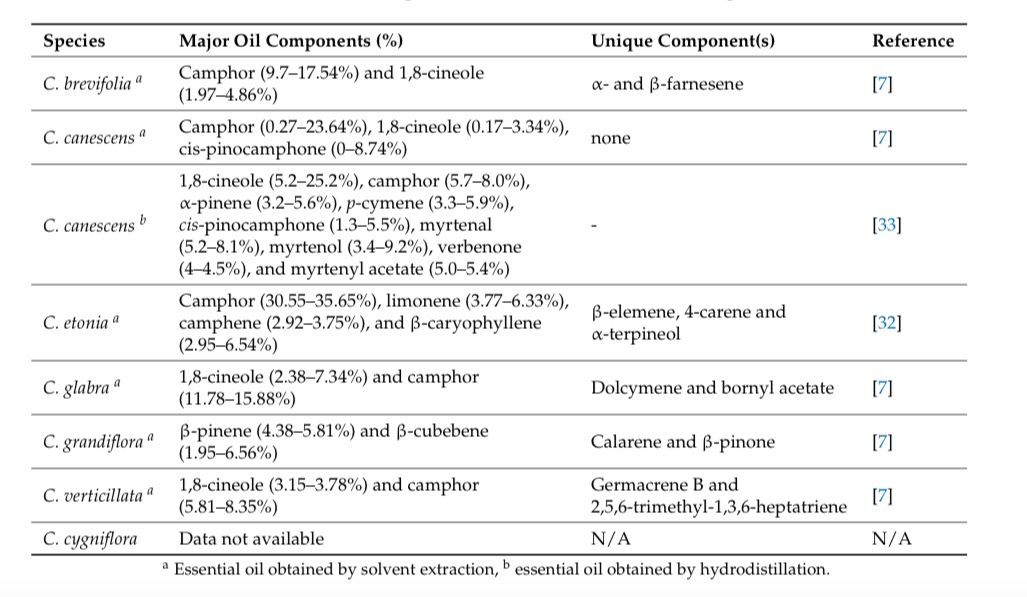
Conradina canescens (false rosemary) is the only species of this genus that is relatively common in its range and the most morphologically variable. It is native to a small area of west Florida, south Alabama, and southern parts of Mississippi. It occurs on sunny, dry sand soils on coastal dunes, in sand scrubs, and in dry longleaf pineland ecosystems. Essential oils of C. canescens were obtained by hydrodistillation and analyzed by GC-MS. The analysis revealed a variety of terpenes, terpenic alcohols, ketones, and aldehydes. The major components of C. canescens oil were 1,8-cineole, camphor, α-pinene, p-cymene, cis-pinocamphone, myrtenal, myrtenol, verbenone, and myrtenyl acetate, in addition to other minor constituents.
C. canescens essential oil was screened for antimicrobial activity and cytotoxic activity but was found to be inactive. Because its chemical composition is comparable to rosemary, C. canescens may be a useful and beneficial herb.